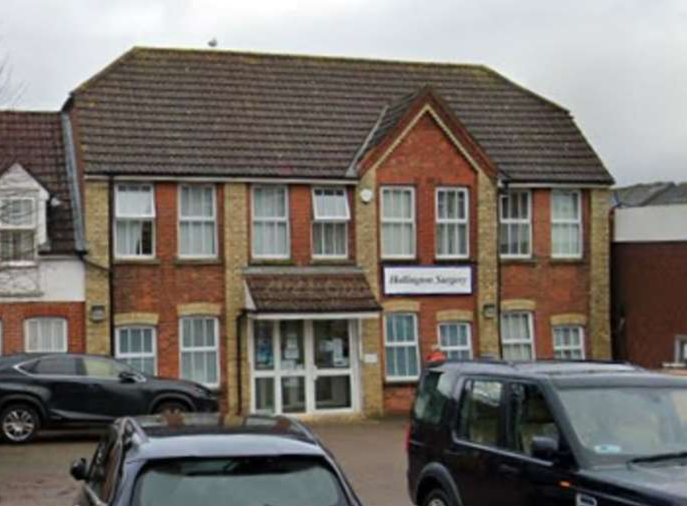
Hollington Surgery

Urgent advice: Cases of invasive meningococcal disease confirmed in Kent

Statement issued by the UK Health Security Agency on 15 March 2026.

The UK Health Security Agency (UKHSA) and NHS are arranging antibiotics for some students in the Canterbury area of Kent following a number of cases of invasive meningococcal disease. The specific strain has not been identified at the present time.

For more information including signs and symptoms, please click on the link below:

Cases of invasive meningococcal disease confirmed in Kent - GOV.UK

UKHSA helpline for the public. Opening times are Monday to Friday from  9am-5pm – 0344 225 3861, if you have no symptoms but are concerned you have been in contact with a confirmed case or have a general enquiry.

Criteria for prophylaxis: 

contact with/or self-reported contact with a confirmed case of meningococcal diseases/meningitis

Living on the Kent University Campus

Attended the Chemistry night club on 5th,6th or 7th March 2026 

Available  at: 

  • Senate Building, University of Kent, CT2 7NZ -  Open daily from 9am to 8pm.
  • Gate Clinic, Kent and Canterbury Hospital, Ethelbert Road, Canterbury CT1 3NG - Open daily from 8.30am to 7.30pm.
  • Thanet Community Health Hub, Northwood Road, Broadstairs, CT10 2WA - Open daily from 8.30am to 8pm (last patient 7.30pm).
  • Westgate Hall, Westgate Hall Road, Canterbury, Kent, CT1 2BT - Open daily from 8.30am to 7.30pm.

Health Publications orderline: https://www.healthpublications.gov.uk/Home.html

Meningitis NOW: https://www.meningitisnow.org (Tel: 0808 801 0388)

Meningitis Research Foundation: www.meningitis.org (Tel: 0808 800 3344).

National guidelines on the management of meningococcal cases and their contacts can be found at: https://www.gov.uk/government/publications/meningococcal-disease-guidance-on-public-health-management

Preventing the spread of meningococcal disease

The best way to stop the disease spreading is by giving antibiotics to the very close contacts of the patient with the illness. That usually means that only people who live in the same house as the sick person need treatment.

There are numerous strains of the meningococcal infection. The MenACWY vaccination gives good protection against MenA, MenC, MenW, and MenY and is routinely offered to teenagers in school Years 9 and 10. However, this vaccine does not protect against all forms of meningitis. Other strains such as MenB can circulate in young adults, which is why it’s important to know how to spot the symptoms of Meningitis and septicaemia as early detection and treatment can save lives.  

Symptoms of meningococcal disease

It is sensible to be aware of the main signs and symptoms of meningococcal meningitis and septicaemia, outlined below.

Some common signs and symptoms of meningococcal disease

High temperature

Rapid breathing

Vomiting or diarrhoea and stomach cramps

Joint or muscle pain

Cold hands and feet

Severe headache

Pale blotchy skin

Stiff neck

Confusion and/or irritability

Dislike of bright light

Drowsiness or difficult to wake

Rash or bruising rash

Seizures or fits

One or more of these symptoms may develop and they can appear in any order.

Meningococcal disease can be hard to identify at first because it can be like a bad case of flu. However, anyone affected with meningococcal disease will usually become seriously ill within a few hours. You should keep checking yourself/ your child if they are unwell and contact your GP (family doctor) or NHS 111 for advice if you have any concerns.

If you become worried about your/your child’s condition, particularly if they are getting worse, seek medical help urgently at the closest A&E Department or by dialling 999.

Be watchful and use your instincts. Early treatment can be lifesaving.

Further information on meningococcal disease is available from:

The Meningitis Research Foundation, www.meningitis.org telephone: 0808 800 3344

Meningitis Now, www.meningitisnow.org telephone: 0808 80 10 388 helpline email address: helpline@meningitisnow.org

Walk-in Clinic

We have a walk in clinic on Saturday 31st January 2026 at Sydenham House Surgery between 8-11am. It is on a first come first served basis. Once full, if you need to speak to a GP please contact 111 or if it is an emergency please call 999.


eConsult Banner

Hollington Surgery is based in Ashford, Kent and forms part of the Sydenham House Medical Group

Calendar icon

APPOINTMENTS

Pills icon

PRESCRIPTIONS

Microscope icon

TEST RESULTS

List icon

REGISTER WITH PRACTICE

Magnifying glass icon

SERVICES

Clock icon

OPENING TIMES

Heart icon

SELF-REFERRAL

Note icon

REQUEST A SICK NOTE

People Icon

PATIENT PARTICIPATION GROUP

Non-urgent advice: Risk Stratification

You might spot something in your NHS App called segmentation. Don’t worry – it’s not a test result you need to act on!

Think of segmentation as us creating a simple “map” of our patients’ health and wellbeing needs. This helps us understand what matters most to you, so we can make your care more personal and timely.

✅ No action is needed from you – it just helps us help you.
ℹ️ More information can be found here.

Practice News

Have Your Say

NHS Friends and Family

Error:
Error:
Error:
This form is protected by reCAPTCHA and the Google Privacy Policy and Terms of Service apply.
surgery photo
Page last reviewed: 18 March 2026
Page created: 28 December 2023